
DSQ blog
The gift of silence
Some years ago a scientific research group put out a request for antique objects, ornaments, artefacts, containing air that had been sealed in when they were made. The idea was that this air could be analysed for levels of pollution that existed in Victorian times, or whenever the object was made, in comparison with modern levels.

© Victoria and Albert Museum, London
The sealed air makes me think of the silences in Haydn’s music. Surrounded and sealed by the notes around them, Haydn’s silences are pockets of silence from the 18th century. We are connected to the silence that he experienced and that listeners have experienced and will experience whenever the piece is played. It is also, for some, a communal experience of awareness of a greater universal silence, in the listening present moment of a performance. (In a way, the silence gives us a more authentic experience of the 18th century than the actual notes, because the sounds that we hear are the result of interpretation and such things as the sounds of the instruments and styles of playing, which have changed – but silence hasn’t.)

Haydn Op 50 No 5 – 2nd movement silence before reprise of the main theme
Haydn leads us to the silence, enabling it to grace our lives for a moment. Perhaps this is his greatest gift to us.
There is another striking silence in this quartet – if silence can be striking.

Haydn Op 50 No 5 – silence in 1st movement
This one is particularly clever. It catches the players off guard – a deliberate banana skin moment when the music evaporates unexpectedly. Where has the music gone?! How are we going to get it back again? Silence rules. Everything comes out of silence and goes back into silence..
What follows this particular moment of silence is a passage of astonishing harmonic invention. It passes by quite quickly so here it is, slower.
Wagner – yes, Wagner!! – comes to mind. I would never have imagined it in Haydn. It just goes to show how original and modern Haydn was in his writing. With minimal means, Haydn breaks the bounds of the formal constraints of classical structures.
The more we play some pieces of music, the more they reveal themselves to us – and often the more mysterious they become. Could this be a definition of great music? It is certainly the way of Haydn quartets which, with seemingly simple resources, give us so much to ponder and enjoy.
Enigmas and dreams
It is always good to come across composers who we have never heard of before but whose music comes to life with vivid immediacy when the bow strokes the string. One such composer is Ignacy Dobrzyński (born in what was then Polish-Ukraine), a fellow classmate of Frédéric Chopin at the Warsaw Conservatoire.
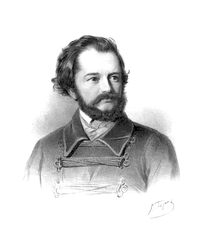
Ignacy Feliks Dobrzyński 1807 – 1867
Dobrzyński and Chopin were encouraged by their teacher Józef Elsner to incorporate polonaises, mazurkas and other traditional Polish folk music into their compositions. Their paths were ultimately very different. Chopin was at the forefront of the Romantic movement, his star ever rising. Dobrzyński, famous in his time, became rather lost in the foggy hinterland of less well known composers but his music deserves to be heard. We are pleased to be bringing his quartet in E minor op 7 to life.
Dobrzyński doesn’t step far out of the magnetic field of Joseph Haydn’s influence in his quartet.

Frederick Wilhelm II of Prussia, dedicatee of Haydn’s op 50 string quartets
Haydn’s op 50 no 5 is not one of his better known quartets but it is as supreme an example of quartet writing as any – succinct, unpredictable, fascinating. The dream-like slow movement holds its magical spell throughout its relatively brief appearance – a reverie in sound. What is the reverie about? Who knows?! This is surely one of the key elements of the very best art – that it offers our imagination opportunities to roam and dream without boundaries or foregone conclusions.
Shostakovich’s music stimulates the imagination too. What is the link between the 7th string quartet dedication – to his recently deceased wife – and the music within this work? (He was by all accounts deeply distressed by her death.)

Nina and Dmitri Shostakovich 1943 Photographed by A. Less © 2001 Cultural Heritage Series/Artistic Director Oksana Dvornichenko
As with so much of his music, we are left guessing to a large extent, and we are left with enigmas. One enigma in this work is announced very clearly and meaningfully by the viola near the beginning of the 3rd movement. After the violins and cello have launched into a cascade of violent semiquavers (described by some as a dog barking), the viola plays four quiet notes. They clearly mean something. But what? The notes can be analysed as forming a theme or part of a code but their presence in the context of the movement seems extremely telling, and yet we will never know for sure what the inner meaning is. We are simply drawn into a place where, in witnessing the enigma, we validate its potential to stimulate the imagination.
I feel a strong influence of the faster, turbulent section of Tchaikovsky’s Romeo and Juliet in this third movement. It is unbridled energy, fearless, fearsome. Perhaps the ending of the work wouldn’t be so effective without this sword-fight of a movement, which normally results in a few lost hairs in all respects. See you at the next series, when we’ll be wearing some pretty fetching wigs, no doubt.
The emancipation of the cello
It was difficult to keep a tab on Boccherini. At closing time he would already have travelled to another country, avidly seeking his next musical employment.
Born in Lucca, Italy, in 1743, he started playing the cello aged five, initially taught by his father. He was sent to study in Rome when he was thirteen. Father and son travelled to Vienna in 1757 to play in the Burgtheater orchestra. He subsequently moved to Spain, in the employment of royalty, where his career really took off.
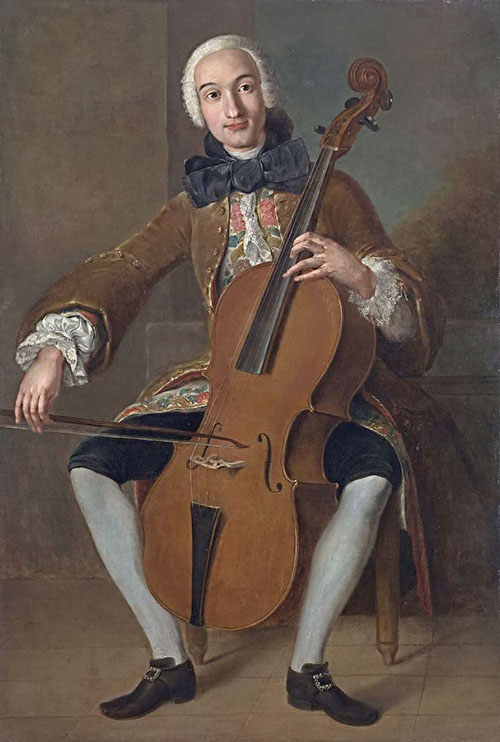
Luigi Boccherini, oil on canvas, Italian school, 1764–67; National Gallery of Victoria, Melbourne.
Fashion has certainly changed since Boccherini’s time. What a fantastic outfit he is wearing! This painting records very accurately, too, the bow and cello of the period and the method of playing it – the bow hold, left hand position and the way the cello is supported by the legs rather than with the aid of a spike in the base of the cello resting on the floor, as is the way with modern cello playing.
Op 2 No 1, in our current concert series, is believed to be Boccherini’s first published quartet (1761), and as such it is probably one of the first string quartets ever written, contemporaneous with Haydn’s first quartet works.

Frontispiece of the first edition of Boccherini’s Op 2 quartets, published by Vernier, Paris, 1761
This title page is a veritable treasure trove of information. The meaning of symphonie/symphony has changed since Boccherini’s time. He used it in the sense of people playing together rather than the subsequent transition of the meaning to imply something more large scale and orchestral. Then he says ‘O sia quartetti’. This suggests a massive shift into new territory – where the four instruments together were the new symphony – the new togetherness, which he invited people to enter into, with his dedication ‘to true amateurs and connoisseurs of music’. This was music for everybody to enjoy, in their homes, in a way that was conversational and intimate. There was one caveat not mentioned, though. You had to have a very good cellist in your quartet…
Boccherini was the cello virtuoso of his age and even in the earlier works the cello is given way more to do than was considered proper up to that time. It could be described as an emancipation. As a result cellists both love and dread his music. However, whatever feats of musical gymnastics the cellist is required to do, somehow this music generally maintains an air of gracefulness and tender expression – so characteristic of Boccherini.
The benefits of diplomacy
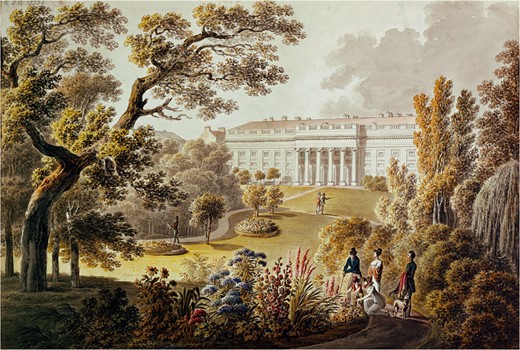
Palace and Garden of Prince Razumovsky in the Viennese Suburb of Landstrasse (c. 1825). Watercolour by Eduard Gurk (1801–41). Wien Museum. Photo: Imagno / Getty Images
Ludwig van Beethoven (1770 – 1827), so fond of walks in woods and in the countryside, must have been in his element in the extensive gardens of his patron Count Andrey Razumovsky (1752 – 1836), the Russian ambassador in Vienna. Extensive is an understatement. The Count’s residence and gardens were conceived on a grand scale to impress. The mannered, ‘artificial’ style of French gardens that had been popular was given short shrift. English garden design was chosen instead, showcasing nature through irregular, secluded paths and viewpoints onto magnificent natural vistas. One can easily imagine Beethoven’s 6th (‘Pastoral’) symphony – dedicated to Count Razumovsky – as the soundtrack to a tour around the gardens.

Dancer (1809-1812) by Antonio Canova, commissioned by Count Razumovsky
Razumovsky was an art collector and played the violin. He also played the torban, a Ukrainian traditional instrument – with good reason; he was born into Ukrainian aristocracy and clearly valued his Ukrainian heritage.
Without doubt, his artistic interests were bound up with his diplomatic role. Conveying an impression of an acute awareness of pan-European culture was part of his diplomatic mission.
His enthusiasm for music extended to employing an excellent string quartet led by Ignaz Shuppanzigh – a good friend of Beethoven – as part of his numerous employees. Razumovsky even provided them with pensions on their retirement.

Ignaz Schuppanzigh (1776-1830)
The Schuppanzigh Quartet holds an important place in the history of chamber music. These were the first musicians in Europe whose careers existed around chamber music rather than orchestral or solo playing. They also premiered many important new works, including the three Op 59 quartets that Razumovsky commissioned Beethoven to write.
All of Beethoven’s ‘Razumovsky’ quartets include Russian themes, although it is unclear whether this was a request by the Count to include them or whether Beethoven included them out of respect and gratitude. The slow movement of Op 59 No 3, which we are playing in our current programme, contains the most Russian sounding music in this quartet – possibly suggesting the vast expanses of the steppes rather than the luxury of sumptuous palaces.
Part of Razumovsky’s palace burnt down in the early hours of New Year’s Day 1815, the evening after a ball at which the guest of honour had been Tsar Alexander 1. A large amount of Razumovsky’s art collection went up in flames. Distraught, he became a shadow of his former self, living in seclusion in Vienna until his death in 1836.
Wealth and influence might fade away but Beethoven’s music speaks to each new generation with startling urgency.
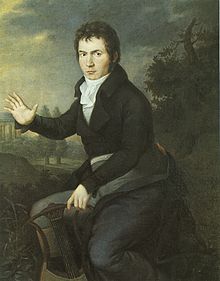
Ludwig van Beethoven by Joseph Mähler (1804-5)
The ecstatic condition of Erwin Schulhoff
We live in a troubled world and when we are faced with such an uncertain future, it is good to have a song that lifts the spirits.
Written by Burt Bacharach and Hal David, this fabulous song is as relevant today as when it was written in 1965.
Bacharach studied composition with Darius Milhaud, one of the composers in the group known as ‘Les Six’. Milhaud is the dedicatee of Erwin Schulhoff’s Five Pieces for String Quartet (1924), which is in our forthcoming concert programme. Milhaud and Schulhoff were exact contemporaries and kindred spirits in the way they incorporated jazz and traditional music into their compositions.

Darius Milhaud 1892 – 1974
Erwin Schulhoff 1894 – 1942
We are excited to be including Schulhoff’s music in this programme. It is provocative, even subversive music, and the string writing is superb. Schulhoff wrote in 1919: “Music should first and foremost produce physical pleasures, yes, even ecstasies. Music is never philosophy, it arises from an ecstatic condition, finding its expression through rhythmical movement”. He was a very keen dancer, often dancing for many hours in nightclubs. He was also a brilliant pianist who had a penchant for ragtime and jazz, both of which are embedded in much of his music.
From the outset of the Five Pieces it is clear that dance is central to the work. A Viennese waltz is at play, but not as we know it in waltzes by Johann Strauss and others, but in a disjointed, somewhat grotesque way that somehow conveys the spirit and energy of the waltz and yet…..a waltz is and always has been in three time whereas Schulhoff here contrives the waltz feel within a structure of two beats in a bar, so what the listener hears is decidedly not as it looks on the page. It could be described as an inverted version of the baroque hemiola, where a piece in three beats in a bar suddenly sounds like two in a bar. Each movement of the Five Pieces is dance based – forming a suite reminiscent of the baroque suite form. After the waltz movement, there is a Serenade, then a movement infused with Czech folk music, a Tango and finally a fevered Tarantella.
Schulhoff clearly loved dance but couldn’t resist undermining it and challenging the conventional viewpoint. His friendship with the painters Otto Dix and George Grosz, who both drew attention to the horrors of war and the prevailing fascist politics of the 1920s in Germany in an unremittingly critical way, stimulated Schulhoff’s anti-establishment nature.

‘To Beauty’ by Otto Dix (1922)
Inevitably his Communist inclination became an increasing issue with the authorities; he became persona non grata, was unable to get a visa to go to America and ended up in Wülzburg prison camp in Bavaria. He died of tuberculosis there in August 1942.
Schulhoff gives the viola considerable prominence in this music. (As it happens, his sister, an artist, was called Viola.) He seems to be drawing on what could be described as the viola’s subversive tendencies – the way it can subtly transform music from within the texture of the ensemble, and its ambiguous pitch – both high and low in range. Bringing this voice to the fore is a brazen upturning of prevailing norms.
It is a privilege for us to play music that broke boundaries at a time when boundaries were clearly and harshly defined. It is a powerful reminder of the way that art can challenge – particularly relevant to us today in the context of authoritarian regimes. Schulhoff didn’t survive the particular regime of his time. Neither did the regime ultimately. His music, his voice, lives on though, still challenging, still inspiring.
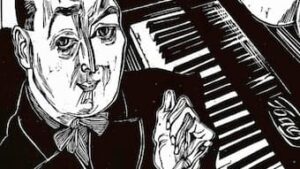
Woodcut by Conrad Felixmüller of Erwin Schulhoff, Prague 1924
More Spohr
Rehearsing the first movement of the Spohr sextet. Gentle, warm music that perhaps doesn’t have the depth of Brahms but its texture bears a striking similarity in parts to the music of Richard Strauss – the lyricism, the shifts of key, the fluttering trills.
There is a lot of trilling to do in Spohr. They are a characteristic part of his music, for sure. He was a well known and influential violin teacher and articulating trills was a skill that was very much a part of his method. What is particularly challenging for the performer is the way he incorporates trills in runs of fast notes that are already tricky enough without having to add extra twiddles! But we enjoy it all the same, keeping our fingers nimble and ready for action.
Here is an example of the trilling going on between first violin and viola in that same movement:
And from the slow movement, less trilling, more collective enjoyment in the melodic sweep and contrasting rhythmic decisiveness.
As mentioned in a previous blog post, one of Spohr’s innovations was in providing rehearsal letters in the music to make it easier for musicians to rehearse the music together, so that they could go beyond such practicalities and engage with more profound issues such as phrasing and interpretation. I wonder what Spohr would have made of the deep philosophical discussion going on here: (you may need to turn up your volume to hear our voices.)
Music of the heart
Compared to many artists and musicians – Berlioz for example, or Mozart, or van Gogh – we know very little about the inner life of Johannes Brahms. He took great pains to dispose of any trail that would give anything away, even requesting of friends that they destroy evidence of correspondence from him. What we are left with is his music, which is surely as confessional as any words written in a letter, and tells us so much about him. Surely he was complicit in this manner of self-revelation.
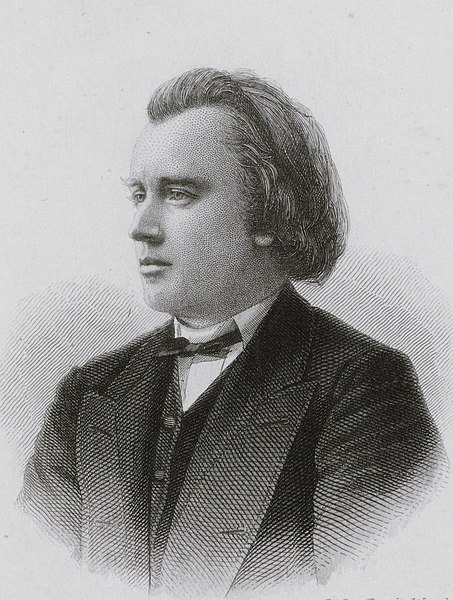
Brahms c. 1860
“If there is anyone here I have not offended, I apologise”, he said when leaving a party. Amusing as it is, it shows how single minded he was. (That such irascibility may have been the result of sleep apnoea is by the by.)
By the time that Brahms composed his Op 18 string sextet in 1860, aged 37, he had written a large amount of music, including, it is believed, twenty string quartets. Most of this he had destroyed in a determined striving for what he thought was worthwhile, particularly in relation to the iconic musical forbears he so revered.
So this sextet was written, surprisingly, before his first official string quartet, Op 51 No 1. He needed time to find a way to form his own statement and response to the acknowledged supreme writers of quartet music – Haydn, Mozart, Beethoven and Schubert. Although he learnt the violin when he was young, his primary instrument was the piano, and he was a piano teacher in the early part of his career. One of his pupils, Minna Völckers, recalled:
‘Between Friday and Tuesday I had to learn a study by Cramer, a prelude from Bach’s Well-Tempered Clavier and the first movement of a sonata by Beethoven. That seemed to me to be an insurmountable task but it went better than I had imagined. I had to play him scales every time. He was very exact with everything and placed special emphasis on a loose wrist. Brahms could not be bettered as a teacher. He was gentle and kind, without praising much. I quickly made big strides with him. I really wanted to play some of his compositions, but hesitated to say so to him. My mother did it for me. “Yes”, he said, “the things are still too difficult, but I will play duets with her” and we had to work on his sextet Op 18, which we immediately got down to in the next lesson. I had to play primo, and we went through it very exactly, and my family were also delighted by the fine music. None of us could ever understand the stupid twaddle that one so often heard about him, that his music was confused. Sometimes, if I asked him, he played fugues after the lesson.’
Presumably the version of the sextet mentioned here would have been a piano duet version; this was common at this time, to make such works available for people to play in their homes if they had a piano, which was very likely.
Brahms gained a huge amount of understanding about string playing from two very significant violinists in his life; Joseph Joachim, considered to be the greatest violinist at the time and a lifelong personal friend of Brahms, and Ede Remenyi, who Brahms toured with giving recitals in 1853. Remenyi had Roma music in his blood and Brahms soon started to incorporate elements of this traditional music in his compositions.
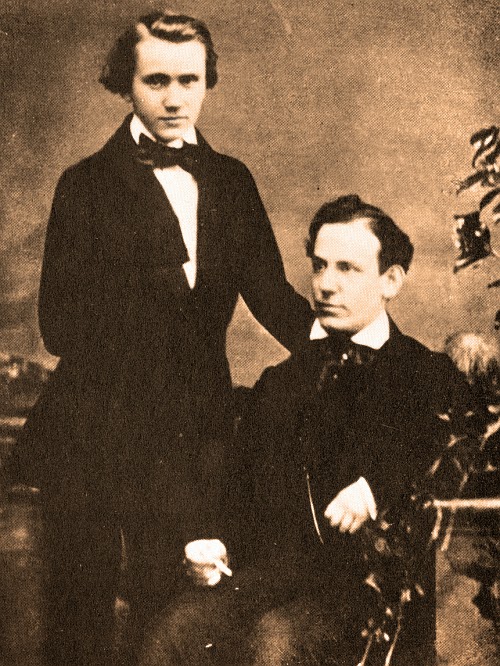
Johannes Brahms (left) and Ede Remenyi
The scherzo of the sextet op 18 has an exuberant energy to it that surely stems from this source of inspiration:
We are probably most familiar with photographs of the older, bearded Brahms. The younger version, as in the two portraits above, makes quite a different impression. It seems that, despite our impression of a very handsome young man, he was not a man brimming with self confidence. It is possible that his decision to break off his engagement to Agathe von Siebold was brought on by the unfavourable audience response to his first piano concerto and he felt that he would be an inadequate partner for her. He was also very close to Clara Schumann but this relationship did not become a permanent commitment.
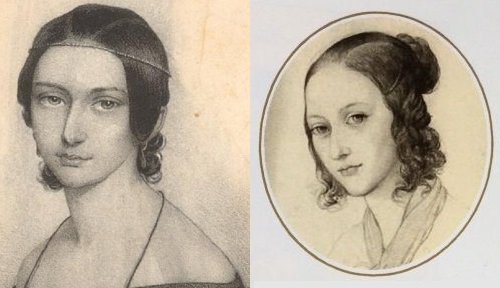
Clara Schumann and Agathe von Siebold
Is there something fatalistic, or even funereal in this passage in the slow movement of the sextet, expressing resignation at his state of being?:
This excerpt shows well Brahms’s affinity with the richer darker tones of the musical spectrum that he found able to achieve with the help of the extra viola and cello in the sextet. The pizzicati of the violins provide a lovely touch, lightening the atmosphere a little. He knew just how to express his inner feelings in musical form.
Four plus two = Spohr
John Braga writes:
The string sextet is quite a rare animal. Neither Mozart nor Haydn nor Beethoven nor Schubert nor Mendelssohn ever composed one.
You wait for ages for a string sextet, then two come along at once! Divertimento String Quartet plus friends will be playing Spohr’s only sextet, written in 1848 and Brahms’s sextet no. 1 written in 1860. So, two mid-nineteenth-century works.
Brahms is of course a major composer, and very popular today. Spohr is not a well-known name to most people, so I want to start by giving some brief details of the man, his life and his legacy.
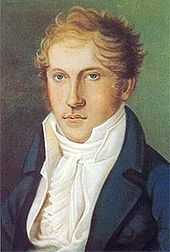
Louis Spohr self portrait
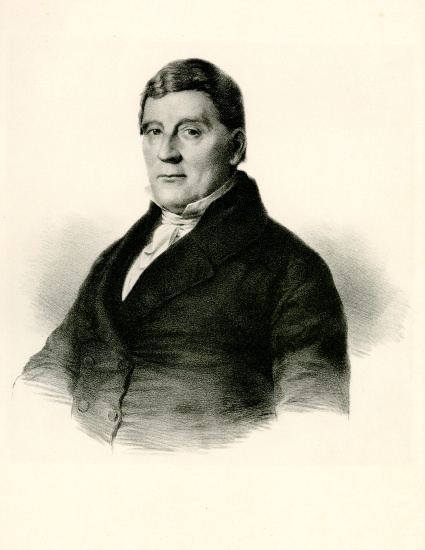
In later years
Louis Spohr was born in Brunswick, North Germany in 1784. To put this date in context, In Vienna Mozart was aged 28 and sadly had only 7 more years to live. Haydn was in full flow in Esterhazy, aged 52, and would live another 25 years. Beethoven was a lad of 14 living in Bonn.
Spohr showed early musical ability and was taken on by the Duke of Brunswick as a violin player in his orchestra at the age of 15. From that time on to the end of his long life he was able to earn a living as a player, conductor and composer. Unlike Mozart and Schubert he never had to starve in a garret. He married an 18-year-old harpist, Dorette Scheidler, in 1806 and they remained happily married until her death 28 years later. He composed 10 symphonies, several operas, 18 violin concertos, 4 clarinet concertos, many songs, 36 string quartets and a very successful octet and nonet. At the height of his fame some German critics hailed him as the natural successor to Beethoven, a claim that will seem somewhat ridiculous to us today but demonstrates how well he was regarded. He toured England on 3 occasions and was well received.
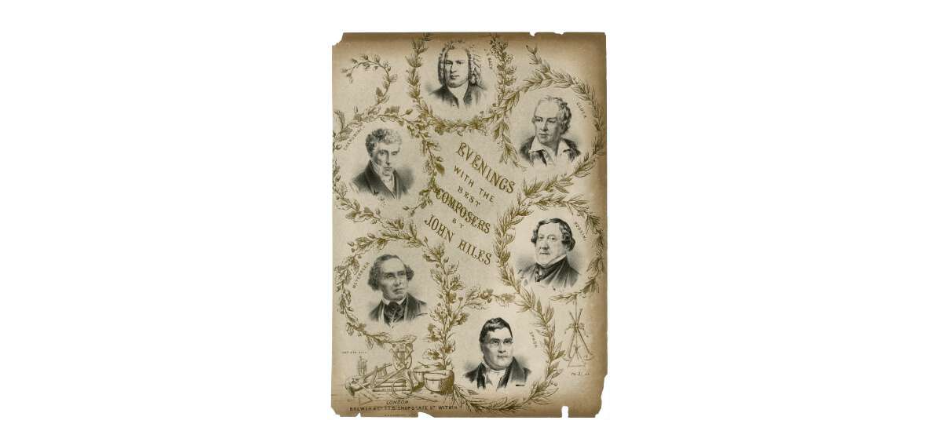
Cover sheet for ‘Evenings with the best Composers’, including amongst others, JS Bach, Gluck, Rossini and Spohr c. 1860 © The Trustees of the British Museum
He also invented the violin chin rest, the baton, and rehearsal marks for which orchestral players should be very grateful.
As a conductor he must have cut an imposing figure. He stood about 6ft 5 inches, and weighed about 18 stone
In 1808 he met Beethoven, and they worked together on Beethoven’s Ghost Trio. Spohr reported that the piano was out of tune and Beethoven’s playing harsh and careless. Later Spohr moved to Vienna and met regularly with Beethoven in coffee-houses and wine-bars. In Spohr’s biography Professor Clive Brown reports that Beethoven would regularly call in at Spohr’s apartment for tea on a Sunday afternoon when he was out for a walk. There he would play on the hearthrug with Spohr’s two young daughters – a delightful picture! It is very likely that Beethoven, who never managed to attract a wife, envied Spohr his cosy domesticity.
The sextet was written in 1848, when Spohr was 64. Not, then, a work of old age, (he died 11 years later in 1859 at the age of 75) but definitely a work of his mature years.
Audiences of the early 19th century always found Beethoven’s music a challenge to listen to. There were abrupt changes of key, strange dissonances, complex rhythms, novel orchestration. With Spohr, audiences were on more familiar ground – they felt safe. Critics, on the other hand, sometimes complained, particularly of Spohr’s later works, that his music did not progress and drew too much on earlier works. Audiences and critics frequently disagree. The conservatism that seemed a fault to critics was seen as a bonus to audiences.
Nobody knows why Spohr decided to use the sextet form for the first time at the age of 64 but he had always been keen to experiment with new formats – double quartets, a concerto for string quartet and orchestra, for example. The sextet offered him the chance to enjoy the extra sonority provided by the depth of 2 violas and 2 cellos.
1848 has come to be known for a series of revolutions that broke out throughout Europe with the aim of removing the old monarchical structures and creating independent nation-states. Spohr was a democrat and a free-thinker and welcomed this new thinking. No doubt he was inspired by the spirit of revolution as he composed the sextet. In fact, in the federation of states that would later become Germany, the revolution did not bring the hoped-for results in that year. But signs of a new order were on the wall. On the score of the sextet, Spohr wrote ‘Written in March and April, at the time of the glorious people’s revolution for the liberty, unity and greatness of Germany.’
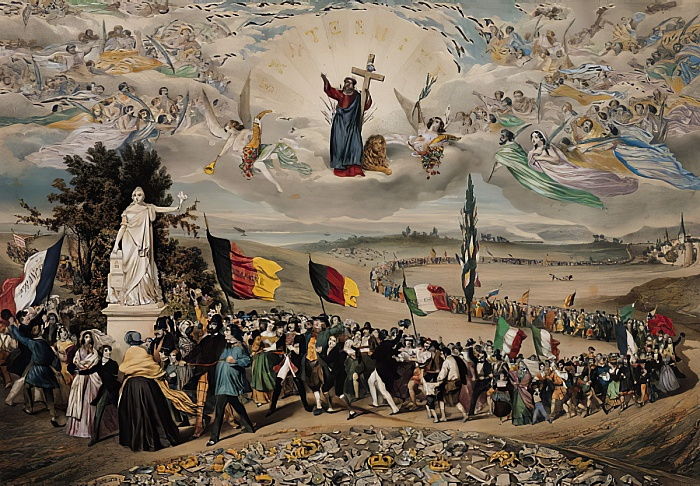
The Dream of Worldwide Democratic and Social Republics – The Pact Between Nations, by Frédéric Sorrieu, 1848
(Note in this picture the German flag – black, red and gold – which first appeared in 1848 as a symbol of German national unity. ed.)
Despite the frisson of revolution in the air at the time, Spohr’s sextet is a beautiful, calm melodious work. Much to enjoy, nothing to shock. It is clearly the work of a composer who is not seeking to prove anything. He does not need to make a loud splash. Mendelssohn had died the year before and Spohr was widely regarded as the senior composer in Germany, a natural heir to Beethoven, rivaled only by the emerging Richard Wagner – a very different type of composer. Brahms had yet to emerge, being only 15 in 1848. Robert Schumann was sadly showing signs of the mental disorder that would kill him.
Spohr makes full use of the extra sonorities provided by the 2nd viola and 2nd cello. Many of his works contain very showy parts for the first violin (Spohr was a violin virtuoso) but here the opening theme of the first movement is played by the violas with the violins providing ornamental trills, very restrained and generally marked pianissimo. After this quiet beautiful first theme, we might expect the second theme to be a contrast, but it, too, is peaceful.
The second theme is equally melodious and serene. Nothing to frighten the horses. The whole work is remarkable for the fact that there are very few forte passages, and no fortissimo. It is also notable for a favourite device of Spohr’s, the fast descending scale decorated with trills – very difficult to play I am told!
The second movement is a tender larghetto, the third an elfin-like Scherzo and the finale is a joyous Presto.
The ‘glorious revolution’ was overthrown in Germany in 1848 and when Spohr was invited to perform in Breslau in 1849 the city was under martial law. Spohr rejected the invitation to perform, stating: “I would find myself unable to breathe, let alone to make music”. He finally made the visit in the summer of 1850 after martial law had been lifted and played the Sextet (perhaps thereby affirming his continuing belief in the principles of the revolution). A Breslau newspaper reported: “…that, at his present age [66] he plays with all the fire and energy of a young man and surmounts the greatest difficulties with amazing vigour and authority, is simply phenomenal; it has never happened before!”
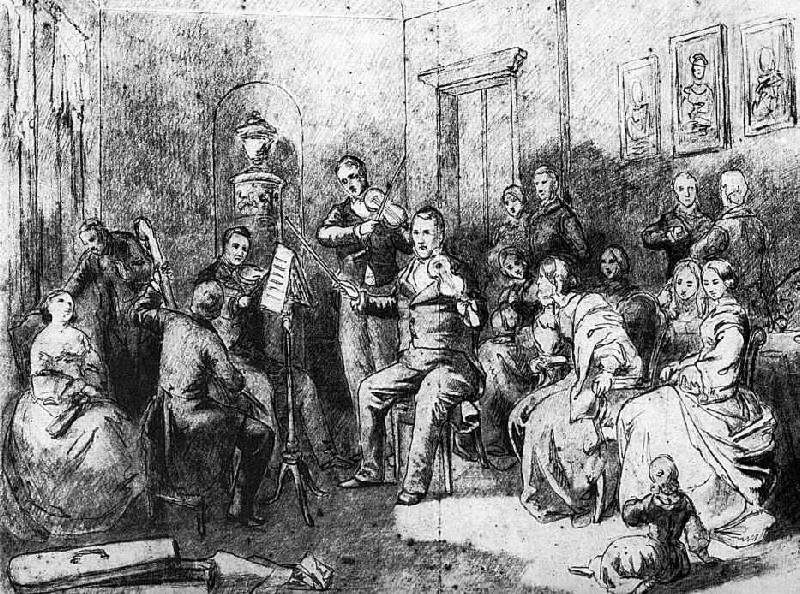
Louis Spohr quartet concert. Note the double music stand.
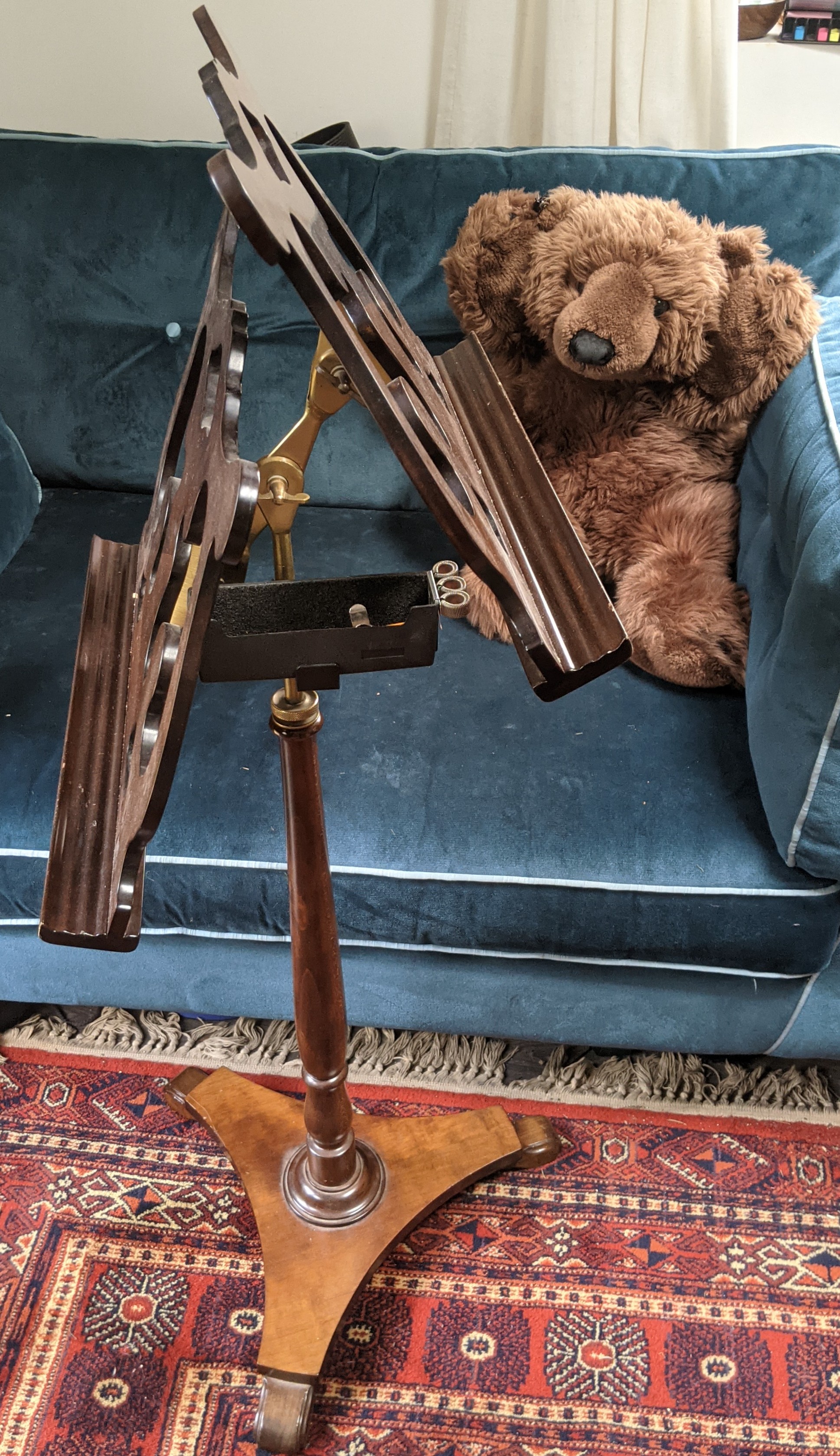
Some of these double stands are still around and very much in use (ed.)
The sound of life
It is safe to assume that when John Dowland – whose poignant ‘Flow My Tears’, in an arrangement for string quartet, we are playing in our forthcoming concerts – took up his post as lutenist and composer at the court of Christian IV of Denmark in 1598, he travelled by ship from London to Copenhagen. In a way, ports such as Copenhagen were the equivalent of modern day airports, making the world seem a smaller place.
In finding connections to distant shores in our current concert programme it is clearer than ever that ‘no man is an island’, to quote John Donne (a direct contemporary of Dowland.) Carl Nielsen, born on the Danish island of Funen in 1865 would have been very aware from a very young age of Copenhagen’s pivotal position in maritime connections to the wider world.
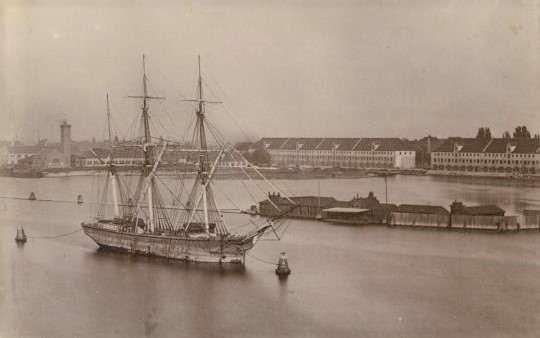
Copenhagen 1860
Nielsen said that ‘I do not enjoy composing music if I continue to do it in the same way.’ His music is certainly very stimulating to play. To say that it is an unpredictable ride might suggest that it is difficult to listen to or hold together coherently in performance but somehow he knows how to make it all work. As a violinist himself (in the Royal Danish Orchestra for a while) he had an inside knowledge of string playing and gained considerably from playing many pieces that stimulated his imagination.
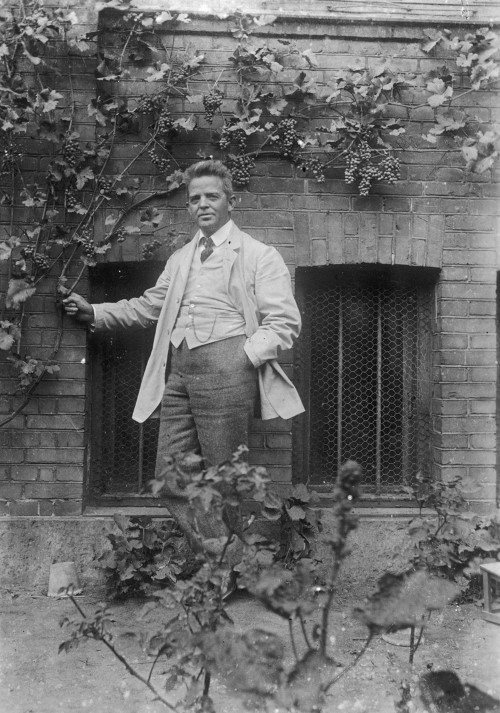
Carl Nielsen 1879
He wrote his second string quartet in F minor mostly while he was spending time in Germany on a scholarship after he had officially finished his musical studies at the Copenhagen Conservatory. He relished the input gained at Leipzig, Berlin and Dresden and was particularly impressed by Wagner’s operas. It is possible to hear a very distinct echo of Wagner’s Siegfried Idyll in the slow movement of the quartet.
He was subsequently to forge his own very individual way unencumbered by the magnetic pull of Wagner. His music is clearly infused with the traditional music of his homeland and in this sense he clearly felt close to the aesthetic of Edvard Grieg, as this little excerpt from the Allegro scherzando shows:
There is definitely a cheeky side to Nielsen. With him at the helm you never quite know where he’s going to take you next but you wouldn’t want to miss getting on board his ship. As he said: “Music is the sound of life.”
A distant shore
The contemporary composer Caroline Shaw lives on the east coast of the USA, in New York – a faraway shore from Topsham in Devon but as was mentioned in the previous blog post the trading connections between Devon and America are historically longstanding. This map shows the trading links – in particular the route to Newfoundland with its fishing riches.
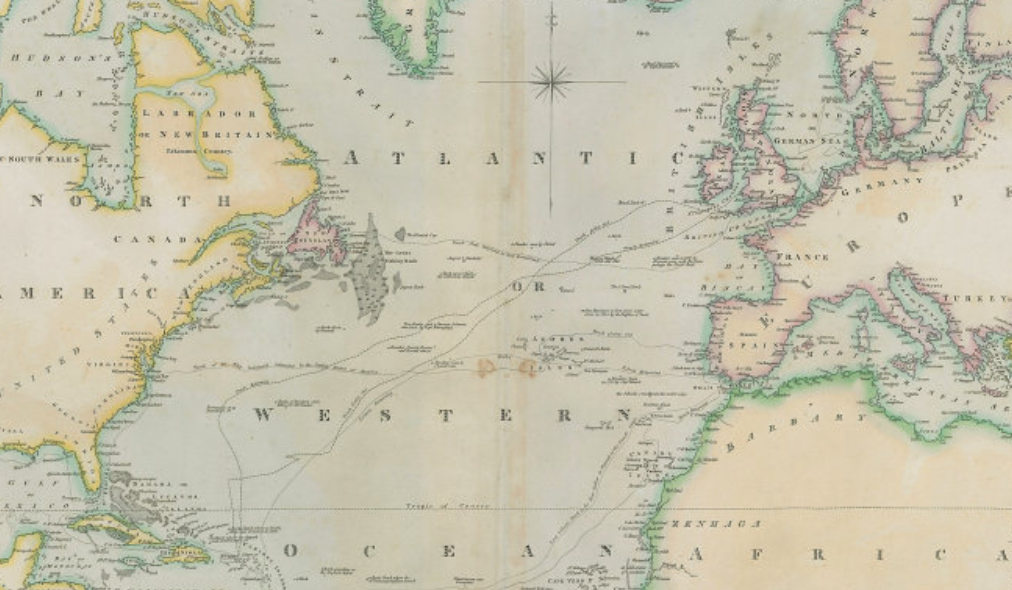
As we will see, the connections across the sea are greater than a map can show.
Shaw was born in North Carolina, studied Suzuki violin with her mother and subsequently developed as much of an interest in singing as violin playing, although she has said that she has a particularly close affinity with the string quartet as she fell in love with the genre when she formed a quartet with friends at school. She has very diverse musical interests and has collaborated with musicians in a number of different genres. She is not easily pigeonholed.
One of the characteristics of Shaw’s writing is how she embraces older musical forms and weaves the old into the new, but without it being obvious or derivative. She uses it as a spark for her musical imagination. In this sense she is writing in a great tradition of course, along with many other illustrious composers.
Entr’acte, which we are playing, is a response to the minuet and trio of Haydn’s Op 77 No 2 quartet. In programming Entr’acte with chamber music by Dowland and Locke written long before Haydn established the string quartet as a genre to be reckoned with, it feels right that Haydn’s significance is implicitly acknowledged, especially as we then go on to play a work (Nielsen’s second quartet) that is so confident and unabashed in the genre.
There is one passage in particular that references Haydn. We play it here:
The passage (very brief) in the Haydn that she has used is between 1:08 to 1:13 in this recording.
You have no doubt noticed that we don’t always play actual notes but move the bow across the string making a rather breathy sound. Shaw has said that, along with her love of singing (and even her instrumental works have a vocal quality to them) she has a particular interest in breath. “I can say that in the last few years, I have become much more attuned to my love of hearing breath. Recently I was recording a project and the audio engineer had taken out a lot of the breath sounds of the voice of the singer, and that’s actually what I love.”
Gaps and silence are built into Entr’acte, contrasting with music often of wild energy. There’s something about this verse by the great American poet Emily Dickinson with its hyphen breaks and mention of waves and breath that reflects the lulls and energy in Shaw’s music – music that is hugely rewarding to play as well as emotionally involving for both listener and player.
The Waves grew sleepy — Breath — did not —
The Winds — like Children — lulled —
Then Sunrise kissed my Chrysalis —
And I stood up — and lived —
(From ‘Three times – we parted’ by Emily Dickinson)
Coming up: Nielsen’s at the helm – watch out!
A sorceress, a magician and a dog
The sorceress Armida was the subject of Joseph Haydn’s 1784 opera, one of his favourite works.
The tale of Armida falling in love with the sleeping crusader Rinaldo at the point of killing him, and transporting him to her enchanted garden seems to have sparked the imagination of a number of composers, artists and writers.
 Rinaldo and Armida. Nicholas Poussin c.1630 (courtesy Dulwich Picture Gallery)

The themes of conflicting thoughts and interests, allegiance (political and spiritual), the consequences of love, as well as the metaphysical elements in the story, provided much scope for somebody like Haydn to have a field day of creative inspiration.
The overture to Armida summarises the course of this drama in a perfectly succinct form. It is sometimes called Sinfonia rather than Overture. It is. in a way, a miniature symphony, the brevity of which Haydn would have had a little chuckle of approval over.

Delphine von Schauroth aged 9, c. 1823 by Langlumé
Delphine von Schauroth is a forgotten star in the firmament of celebrated pianists. She was a close friend of Felix Mendelssohn and by all accounts his muse at the time that he wrote his first piano concerto (1830) – he dedicated the concerto to her. A child prodigy who had toured Europe, her playing deeply affected those who heard her. For instance, one listener wrote: ‘I believe that the philosopher who asserted that the soul resides in the fingertips was either a money changer or he heard Miss von Schauroth play the piano! I speak not at all of the tremendous, almost incomprehensible skill, but only about the characteristic charm of the tenderness and interiority with which she knows how to give rise to the deepest, most secret spirits of the enchanted strings, so that they speak to her and unfold their secretly prevailing powers. As I was leaving, someone was so simple-minded as to ask of me: “How did you like Schauroth?” He could just as well have asked: “How did you like the dawn?” I merely said: “I just saw with my own ears the Graces dance the Iliad on the piano.”’
Her playing came across as somehow magical and enchanted, especially when she improvised, which she did a lot. (Mendelssohn was also a celebrated improviser and all-round brilliant pianist.) It is no coincidence that the epigraph to the above portrait, from Tasso’s Gerusalemme conquistata, is part of a description of the music in the garden of Armida, translated as ‘The others fell silent to listen intently / And the winds stopped the whispers in the air.’
Mendelssohn was the soloist at the first performance of his sparkling first piano concerto in Munich’s Odeon Hall in 1831.

This was, for sure, a large hall (sadly mostly destroyed in the second world war.) Bearing in mind that the pianos and orchestral instruments of that period would have sounded quite different to today’s instruments (arguably more delicately nuanced), the audiences would have needed to listen acutely in such a hall. No doubt they were rewarded with the brilliant and subtle artistry of Mendelssohn and the other performers.
Forty-five years earlier, Wolfgang Amadè(also known as Amadeus) Mozart, was in Prague having travelled there from Vienna with his wife, Constanze, some fellow musicians including the clarinetist Anton Stadler, a servant, and even his dog, all (except the dog presumably) playing word games in the coach.
 The Estates Theatre, Prague. (photo: Andrew Gillett)

It is a wonder that the historic Estates Theatre is still standing and active as an opera and concert venue. It is easy to imagine what it was like when Mozart and his entourage were there, busying around preparing for the first performance of Don Giovanni or rehearsing for the premiere of his clarinet concerto.
At a concert there, on January 19th (1787), Mozart’s 38th symphony, written specifically with the Prague musicians in mind (particularly their outstanding wind players), was given its first performance. After the concert, Mozart stayed on stage, improvising on the fortepiano (an even quieter instrument than the piano that Mendelssohn would play on) for half an hour. The audience was mesmerised. Mozart’s early biographer, Franz Niemetschek wrote: ‘The theatre had never been so full as on this occasion; never had there been such unanimous enthusiasm as that awakened by his heavenly playing. We did not, in fact, know what to admire most, whether the extraordinary compositions or his extraordinary playing; together they made such an overwhelming impression on us that we felt we had been bewitched.’
It is almost as if they were transported to Armida’s enchanted garden by Mozart’s music and his playing.
Prague helped provide the means and inspiration for several of Mozart’s last supreme musical achievements; works that continue to astound and marvel with their infusion of humanity, empathy and originality.
