
DSQ blog
Motherly imagination
“Who Is Musical?’ – not perhaps the most eye-catching title for a book, but this is indeed the title of a book by Brahms’s close friend Theodor Billroth, who Brahms dedicated his Op 51 string quartets to. Billroth was working on the text of this first ever scientific study of the nature of musicality late in his life and it was published posthumously.
A highly regarded and innovative Viennese surgeon, he was also a very good musician. I find it moving playing the viola part of the Brahms quartet knowing that he would have played this very part and that to some extent Brahms would have had his friend in mind in his musical imagination.
Billroth stated that “it is one of the superficialities of our time to see in science and art two opposites. Imagination is the mother of both.”
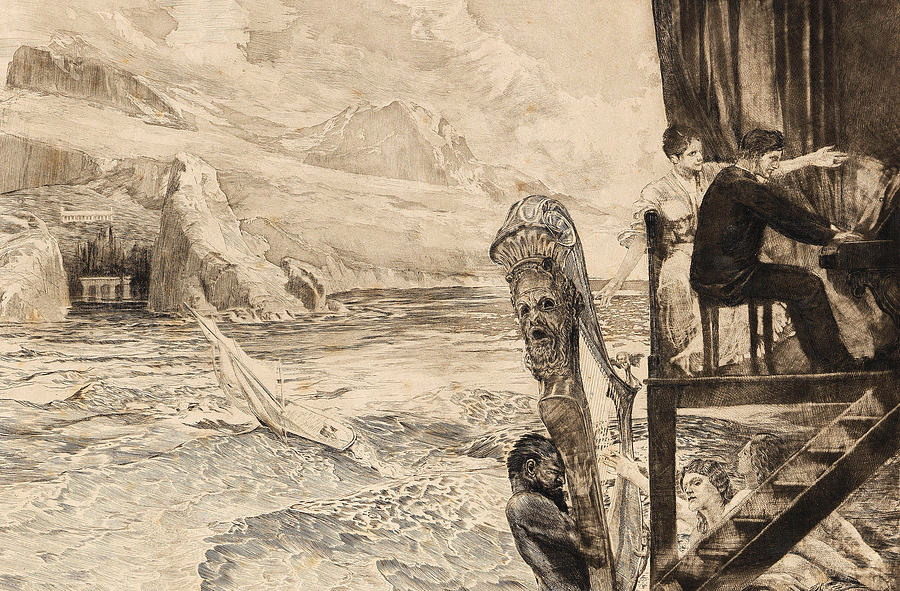
Max Klinger. Brahmsphantasie: Accord 1894
Brahms was a great enthusiast of the art of Max Klinger – and Klinger was equally enthusiastic about Brahms’s music. They were without doubt artistic soul mates, in touch with their subconscious and finding ways to express their imagination.
Brahms felt that writing his music was about realising what he heard in his dreams, the sphere of imagination. Perhaps with science so pivotal and revered today, and with the arts being existentially challenged, the friendship of Brahms, Klinger and Billroth can show us the importance of imagination. Against all odds, we can still dream.
My First and Last Love
Music was my first love
And it will be my last.
Music of the future
And music of the past.
To live without my music
Would be impossible to do.
In this world of troubles,
My music pulls me through.
John Miles ‘Music’
Songwriters: Breyon Jamar Prescott, Michael C. Flowers
© Universal Music Publishing Group, Kobalt Music Publishing Ltd.
I was rather keen on this song when it came out and still retain a curious fondness for it. I related to its obsessive, repeated message and found it musically and structurally interesting – well, more interesting than some. Apart from its obvious message, the lyrics also summarise the lives of many composers and artists who have produced extraordinary and elevating works of art, often in the midst of suffering and difficulty. Beethoven, Schubert, Vermeer, Van Gogh, Proust, Joyce – the list goes on and on.
The lyrics also convey something of the compulsion musicians have to make music, and touch on the reason why people act on their wish to experience live music and go as far as venturing out to attend concerts – when it is safe to do so!
Since this quartet’s live public music making was terminated, albeit temporarily, along with music making the world over as a result of lockdown, we have enjoyed putting together some videos to connect with those who have been drawn to our music making, and to show that we are still up for it. Obviously we are aware that the videos may reach an audience but it is a very different sort of chemistry from playing live, interacting with each other on the spur of the moment, and with an audience nearby very much involved in the experience and responding very personally to what the music conveys.
It means a huge amount to us as musicians that you the audience are there, and not just for financial reasons! ‘This gift (of music) will not be like the alms passed on to the beggar; it will be the sharing of a man’s every possession with his friend.’ (Hindemith) To share our music making live is an act of sharing which goes both ways. The way an audience perceives the music and the music making is incredibly important. In a way, music only properly exists and comes into being in this context.
There is no doubting, too, that music can affect us and change us deeply, and that music, like writing and the visual arts too, also has a way of shedding light on our contemporary situation, politically, socially, emotionally, even if some of the music may have been written a couple of centuries ago.
For these reasons it is a huge loss not to be able to make live music and have this communal experience of reflection and inspiration. In fact it seems to present a huge question: without the interaction of performer and audience, what is the meaning of music? It would be interesting to hear your thoughts…
Those who attended Schubert’s small chamber concerts (‘Schubertiades’) obviously had no concerns at all about social distancing:
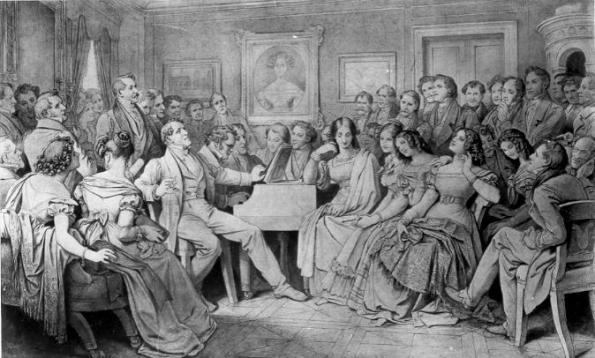
Schubertiade. Drawing by Moritz von Schwind (www.bezirksmuseum.at)
This drawing shows how many people there actually were crowded together at these performances. (Maybe there is a little artistic license. Von Schwind was a close friend of Schubert and would have wanted to show him in the very best light.) The scene reminds me ever so slightly of the concerts that we have done in the round, where the communal experience and role of music feels particularly heightened.
‘It is a fallacy that the artist invents for himself alone. No man lives or moves or could do so, even if he wanted to, for himself alone. The actual process of artistic invention, whether it be by voice, verse, or brush, presupposes an audience.’ Vaughan Williams
A Barber bar by bar. Rossini’s Barber of Seville Overture.
Rossini’s Barber of Seville Overture cropped and styled for two.
Created in response to one of our followers who dared to suggest that Andrew might need a haircut as we sink further in to the lockdown situation.
DSQ Prokofiev + Andrew intro
Divertimento String Quartet. Prokofiev String Quartet no 2 – part of the final movement, with an introduction by Andrew Gillett.
Bridging the Silence – Clip from Adagio, string quartet no 1 in C minor by Bruch
Divertimento String Quartet playing part of the Adagio from Max Bruch’s String Quartet. Mary Eade, Lindsay Braga, Andrew Gillett and Vicky Evans
Hoffmeister duet in G major for violin and viola
As the lockdown continues, we share more fun behind closed doors. Oh, and a puppy.
Bach Prelude for two
Social distancing scatters our quartet but brings on a little violin and viola duet. And if that’s not enough there’s a very cute puppy at the end.
Prelude No 17 from 48 Preludes and Fugues by JS Bach. Arranged by Friedrich Hermann.
Lindsay Braga-violin Andrew Gillett- viola
Lace Space
In the current situation that we find ourselves in, where life has largely been put on hold, apart from the valiant key workers who are tirelessly and admirably going about their work, it seems apt to consider the significance of rests and pauses, using music as a starting point. I have touched on the subject of rests in music briefly before in a previous post but I have found myself recently reflecting more extensively on the subject in the light of our enforced break.
Firstly: isn’t lace wonderful! Here’s an example of Honiton lace that has a decidedly spring-like burst of life about it:
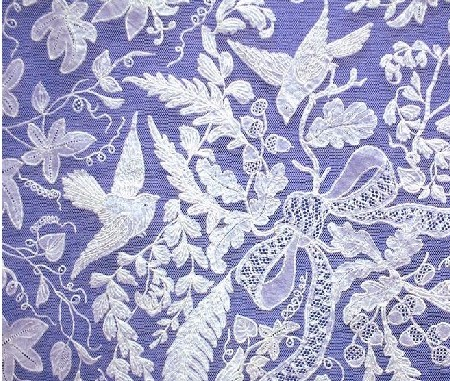
Sample of Honiton Lace circa 1870 from the Allhallows Museum Collection (www.honitonmuseum.co.uk) Photo copyright The Allhallows Museum.
Lace provides a perfect illustration of the importance of rests in music. The needlework represents the notes and the spaces between imply the rests. They co-exist; without the spaces there would be no meaning. (I find that many of my pupils are rather baffled by this concept – that rests are so important and meaningful. In their minds, music is about making sound.)
It’s often not clear to the listener what a profusion of rests exists in the music they are hearing. Often, a player will have a rest when someone else is playing, so the rest is not so noticeable. A good example of the importance of rests in music is the end of Haydn’s string quartet Op 33 No 2 (‘The Joke’), where his use of rests sets up the ‘punchline’ at the very end of the last movement. We played this quartet in a concert series last year. Hopefully some of you might remember the hilarity we all had. You can listen to, and watch, the whole movement here: https://www.youtube.com/watch?v=TiGVNpe_BhY
A very different use of rests is evident in the first movement of Schubert’s G major piano sonata D. 894. https://www.youtube.com/watch?v=lj0J0LpeVGQ The gap in the music created by the rests is a moment of thoughtfulness and calm.
I can’t resist directing you towards Schumann’s fabulous/surreal setting of Heine’s ‘Mein Wagen rollet langsam’. https://www.youtube.com/watch?v=jQ42sPsFBuY The rests here colour the text so aptly and get the imagination going in the listener’s mind. And just listen to the piano coda! Here is the text:
Mein Wagen rollet langsamDurch lustiges Waldesgrün,
Durch blumige Täler, die zaubrisch
Im Sonnenglanze blühn.
Ich sitze und sinne und träume,
Und denk’ an die Liebste mein;
Da huschen drei Schattengestalten
Kopfnickend zum Wagen herein.
Sie hüpfen und schneiden Gesichter,
So spöttisch und doch so scheu,
Und quirlen wie Nebel zusammen,
Und kichern und huschen vorbei.
Translation:
My carriage rolls slowly
Through cheerful green woodlands,
Through flowery valleys
Magically blooming in the sun.
I sit and muse and dream,
And think of my dear love;
Three shadowy forms nod at me
Through the carriage window.
They hop and pull faces,
So mocking yet so shy,
And whirl together like mist
And flit chuckling by.
(Translations by Richard Stokes, author of The Book of Lieder (Faber, 2005))
There are many other such examples of the use of rests in classical music. Please do mention your own favourite examples, by commenting or emailing.
Pauses are a slightly different case but equally relevant to our musing at this time. Again, please do post your own favourite pauses in music (of any sort). One of the most powerful pauses I know is after the monumental build-up and cataclysmic crisis point in the last movement of Bruckner’s 9th symphony. You can find it in the section between 57:15 to 59:30 in this recording: https://www.youtube.com/watch?v=MIJET6NO4-k&t=3565s The pause (a silent pause in this case – some pauses are a note played extra long) gives time to reflect on the crisis point, rest, and move on to a calmer resolution as the work comes to its conclusion.
The four of us wish all our followers good health now and beyond this crisis. We are very frustrated not to be able to perform our next programme to you but are looking forward to a resumption of play as soon as the covers come off, so to speak. We hope to include the occasional musical offering via the Divertimento website, just so you are reassured that we still have a rough idea how to play our instruments and that there is hope on the horizon.
Let’s take up an idea suggested by one audience member and post or email anecdotes of unusual things that have happened in concerts/performances. Do send them in and we will make sure they appear for all to see. I’ll start the ball rolling:
I went to a Bournemouth Symphony Orchestra concert in Plymouth in the early 1970s at which Alan Loveday was supposed to be the violin soloist. When it came to that part of the programme somebody announced that he actually wasn’t going to be there because he had gone to Portsmouth instead of Plymouth. I think the orchestra had been on tenterhooks right up to that point. I can’t remember what they actually played in the end!
Hesitation, Repetition, Deviation
It was sad to hear of the recent death of Nicholas Parsons, the genial presenter of Radio 4’s popular comedy programme Just a Minute.
“Without hesitation, repetition or deviation” has become a catchphrase used in common parlance. It is something that any musician who presumes to stand up and talk about the music about to be played would be wise to bear in mind. As audiences may have noted, I am still very much a learner in this respect. I’d only last a few seconds on that programme.
Turning the rules upside down to make hesitation, repetition and deviation permissible in a musical context, some thoughts have struck me in relation to the works that we are playing in our current concert series.
Hesitation
I suppose the most obvious musical manifestation of hesitation is the pause, indicated by the composer in the printed music by what could be described as a dot with a sideways bracket above it, looking a bit like an all-knowing eye and eyebrow. There isn’t a single pause in Mozart K 421. There are several in the Webern Bagatelles – momentary lulls in the intense abundance of textures and expressions. There are a few more in Beethoven’s Op 59 No 1. He was an inveterate pause man, even more than your most avid dog or cat lover. His most famous work (arguably), his 5th symphony, has two pauses in close succession at the beginning of the piece. Sometimes the pause is used like this for dramatic effect. At other times it marks an important place in the structure of the music where it is time to stop and gather or to stop and allow thought for… possibilities.
Repetition
“What do you call that?” asked a rather bemused and slightly indignant lady who came up to me in the interval of one of our recent concerts. Perhaps I was rather quick in assuming that she was referring to the Webern which we had just played, when it could easily have been that she was reacting to the sight of me in front of her.
The question as to whether the Webern is music at all is a good one. It is such a different sound world to Mozart’s or Beethoven’s.
One of the huge differences between the Webern and both the Mozart and Beethoven is that there is very little clear repetition to hang on to in the Webern. Repetition reassures the listener as well as providing key moments in the narrative structure of the music. Paradoxically, Webern attended to structural aspects of composition with immaculate detail and he was obsessively fascinated by the natural world.
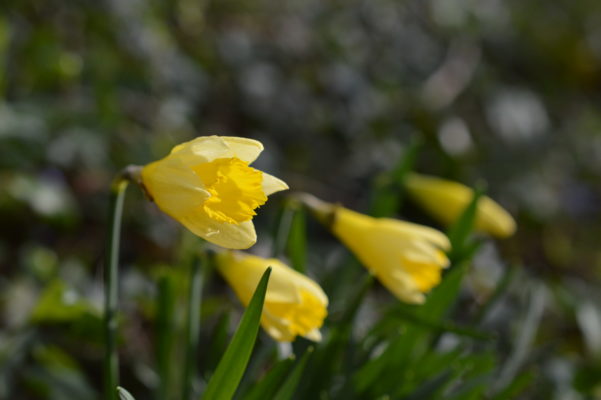
I came across this little group of daffodils in a hedgerow the other day. I was struck by the courage of their blossoming at such a time of stormy assault by the elements. They seem to contain a sense of spring just around the corner, confirming the repetitive cycle of the seasons. Even the identical appearance of the flower heads demonstrates a repetitiveness that exists despite the seemingly random forces in the natural world. A couple of days later I noticed that all the flowerheads were facing a different direction. Repetition can withstand quite considerable reinterpretation and variation. Mozart demonstrates this superbly in the last movement of K. 421 where the main theme is repeated (often hidden in the texture of the music) and each repetition/variation is given its own character and life.
Deviation
I refer to the honourable lady quoted above (to misquote a parliamentary statement), who clearly thought that Webern deviated completely away from an established understanding of what music was. It is clear from contemporary reports that exactly the same was said of certain works by Beethoven when they first appeared.
I have spoken in a previous blog about the benefits of deviation of the musical kind. The way composers deviate sparks interest and debate, for sure, to say the very least, which is the way it has to be as I’ve already taken up well over a minute of your time, if indeed you are still with me!
We do love chatting with our audiences in the interval and after the concert about the music and how people have reacted to what they have heard (and seen!). If you can be there too, do come and chat to us. Do comment too on our blog posts, if you can make the system work… You may even get a reply.
Minor Mozart
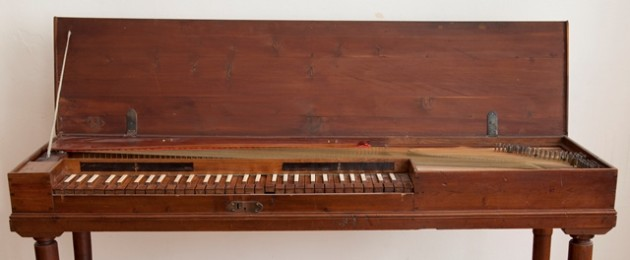
There is an indication at the beginning of Mozart’s K. 421 for the performers to play ‘sotto voce’ – under the voice or hushed. I like to think of Mozart hunched over his clavichord – the softest and most subtle of keyboard instruments – composing such music.
D minor is the key of K. 421; the same key as his Requiem. This quartet is a beautifully balanced work. Despite the D minor basis, there is as much lightness as melancholy because of Mozart’s use of different keys.
Why do composers choose particular keys for the pieces they are composing? Sometimes it is for practical reasons based on the combinations of instruments in the ensemble. Generally it seems a more intuitive choice. It is possible that for some composers it is linked to synaesthesia – the way sounds evince certain colours in the mind of the listener, the colours relating to feelings and moods.
For performers, all keys have a particular physical sensation in the hand so the sensation of playing in a certain key is decidedly visceral. The choice of key by the composer becomes a physical experience for the performer and in live performance this is arguably partly transmitted to listeners. We all feel the key, its colour and character.
We love playing this piece. It always feeds the soul.
A sorceress, a magician and a dog
The sorceress Armida was the subject of Joseph Haydn’s 1784 opera, one of his favourite works.
The tale of Armida falling in love with the sleeping crusader Rinaldo at the point of killing him, and transporting him to her enchanted garden seems to have sparked the imagination of a number of composers, artists and writers.
 Rinaldo and Armida. Nicholas Poussin c.1630 (courtesy Dulwich Picture Gallery)

The themes of conflicting thoughts and interests, allegiance (political and spiritual), the consequences of love, as well as the metaphysical elements in the story, provided much scope for somebody like Haydn to have a field day of creative inspiration.
The overture to Armida summarises the course of this drama in a perfectly succinct form. It is sometimes called Sinfonia rather than Overture. It is. in a way, a miniature symphony, the brevity of which Haydn would have had a little chuckle of approval over.

Delphine von Schauroth aged 9, c. 1823 by Langlumé
Delphine von Schauroth is a forgotten star in the firmament of celebrated pianists. She was a close friend of Felix Mendelssohn and by all accounts his muse at the time that he wrote his first piano concerto (1830) – he dedicated the concerto to her. A child prodigy who had toured Europe, her playing deeply affected those who heard her. For instance, one listener wrote: ‘I believe that the philosopher who asserted that the soul resides in the fingertips was either a money changer or he heard Miss von Schauroth play the piano! I speak not at all of the tremendous, almost incomprehensible skill, but only about the characteristic charm of the tenderness and interiority with which she knows how to give rise to the deepest, most secret spirits of the enchanted strings, so that they speak to her and unfold their secretly prevailing powers. As I was leaving, someone was so simple-minded as to ask of me: “How did you like Schauroth?” He could just as well have asked: “How did you like the dawn?” I merely said: “I just saw with my own ears the Graces dance the Iliad on the piano.”’
Her playing came across as somehow magical and enchanted, especially when she improvised, which she did a lot. (Mendelssohn was also a celebrated improviser and all-round brilliant pianist.) It is no coincidence that the epigraph to the above portrait, from Tasso’s Gerusalemme conquistata, is part of a description of the music in the garden of Armida, translated as ‘The others fell silent to listen intently / And the winds stopped the whispers in the air.’
Mendelssohn was the soloist at the first performance of his sparkling first piano concerto in Munich’s Odeon Hall in 1831.

This was, for sure, a large hall (sadly mostly destroyed in the second world war.) Bearing in mind that the pianos and orchestral instruments of that period would have sounded quite different to today’s instruments (arguably more delicately nuanced), the audiences would have needed to listen acutely in such a hall. No doubt they were rewarded with the brilliant and subtle artistry of Mendelssohn and the other performers.
Forty-five years earlier, Wolfgang Amadè(also known as Amadeus) Mozart, was in Prague having travelled there from Vienna with his wife, Constanze, some fellow musicians including the clarinetist Anton Stadler, a servant, and even his dog, all (except the dog presumably) playing word games in the coach.
 The Estates Theatre, Prague. (photo: Andrew Gillett)

It is a wonder that the historic Estates Theatre is still standing and active as an opera and concert venue. It is easy to imagine what it was like when Mozart and his entourage were there, busying around preparing for the first performance of Don Giovanni or rehearsing for the premiere of his clarinet concerto.
At a concert there, on January 19th (1787), Mozart’s 38th symphony, written specifically with the Prague musicians in mind (particularly their outstanding wind players), was given its first performance. After the concert, Mozart stayed on stage, improvising on the fortepiano (an even quieter instrument than the piano that Mendelssohn would play on) for half an hour. The audience was mesmerised. Mozart’s early biographer, Franz Niemetschek wrote: ‘The theatre had never been so full as on this occasion; never had there been such unanimous enthusiasm as that awakened by his heavenly playing. We did not, in fact, know what to admire most, whether the extraordinary compositions or his extraordinary playing; together they made such an overwhelming impression on us that we felt we had been bewitched.’
It is almost as if they were transported to Armida’s enchanted garden by Mozart’s music and his playing.
Prague helped provide the means and inspiration for several of Mozart’s last supreme musical achievements; works that continue to astound and marvel with their infusion of humanity, empathy and originality.
