
DSQ blog
Let’s play Bagatelle
I was approached in the interval of our first concert of our current concert series by a delegation of three rather ernest ladies who wanted to know what Webern is trying to say in the Six Bagatelles Op. 9 – what the music might mean. I am not sure why they thought that I might have actually had an answer to that question.
It was an understandable question, because it is music so utterly unlike the Mozart quartet that we play at the start of our programme. One might ask then: what is Mozart trying to say? Who knows?! Yes, there is a narrative, of ideas, crises and resolution but what he is actually saying is elusive because it inhabits moods and feelings without the use of words, and therein lies its particular effectiveness.
The Bagatelles are extremely short. In all they last about four minutes. Their brevity is quite startling, and a significant aspect of the experience of hearing them. I think that it is partly because what takes place in that short time is so eventful and detailed – they are particularly tricky pieces to play – and there is hardly time to assimilate what you’re hearing because they are over in a flash. In a way they are like small pictures, or displays of dried flowers or rocks, that require huge concentration to take in every minute detail of their character.
I don’t know what this music means but it is possible to say that Webern is expressing two things at least. Firstly, he is exploring the wonder of sound, which for him includes dissonance as being organically inherent in the music just as it is in nature. As Webern said in a lecture in 1932: ‘Anyone who assumes that there’s an essential difference between consonance and dissonance is wrong, because the entire realm of possible sounds is contained within the notes that nature provides and that’s how things have happened. But the way one looks at it is most important.’ That last sentence makes a very pertinent point, if challenging.
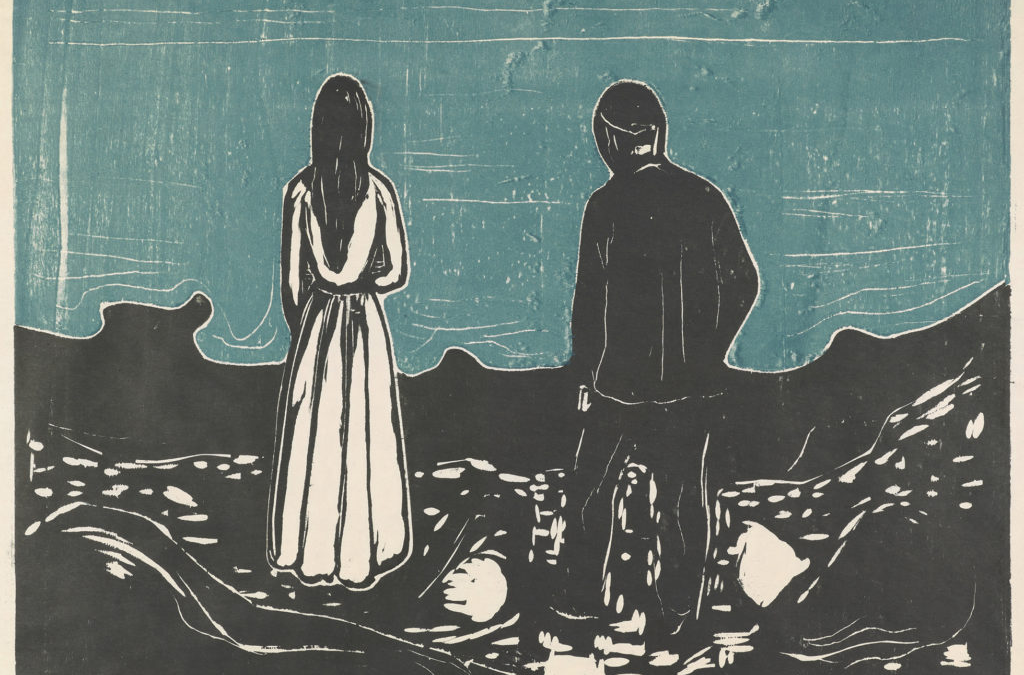
Secondly, I have a strong impression of this music as being indicative of the zeitgeist of the time that it was written (in the lead-up to the First World War). It brings to mind the art of Edvard Munch in particular
and somehow reflects the intellectual ruminations of significant figures such as Freud and the playwright Strindberg. Much was being questioned and the old order was felt to be inadequate in many areas of life. This manifested itself in the dissolution of traditional harmony in the ‘new music’ of Schonberg, Webern and Berg. Such a work as the Six Bagatelles certainly challenges preconceptions and without doubt makes us think about the way we look at things, which surely is a salutary state of mind to be in.
To follow – minor Mozart
Beethoven Unleashed
Andrew writes…
‘Beethoven Unleashed’ (BBC Radio 3’s title for their year-long Beethoven fest to mark the 250th anniversary of his birth) is now under way. This morning in ‘This Week’s Composer’ I heard a broadcast of the ‘Grosse Fuge’ for string quartet, Op 133. Talk about unleashed! It almost made me forget my need for lunch. This is music of a determined striving, emotionally and intellectually. It doesn’t steal upon you like, say, Schubert’s music or Mozart’s; it wrests your consciousness away from mundane matters and into its obsessive-compulsive vortex. You have to listen whether you want to or not.
It has made me think what a silly title ‘Beethoven Unleashed’ is. Neither Beethoven nor his music were ever leashed, from beginning to end. Beethoven’s 9th must be some of the most unleashed music ever written (along with Berlioz’s Symphonie Fantastique, Stravinsky’s Rite of Spring, the jazz of Thelonius Monk, and others) – it just needs some unleashed musicians to make it pounce live off the score. I guess this is what the Unleashed title is saying.
At the very beginning of Op 59 No 1, which we are rehearsing in readiness for our concert series, the cello is certainly unleashed, being given a delightful flowing solo to launch the music on its way. The musicians who first played this work thought the idea of giving the cello such prominence at the beginning was barmy and it caused considerable consternation – even hilarity. To us now it feels like a gift, as does so much fine music.
There are curious passages in Op 59 No 1 that seem to be like snapshots into Beethoven’s mind-at-work as he strives onwards and upwards compositionally. The second movement in particular is decidedly curious, but also very catchy. It is like dreaming of dancing – sometimes elfin and sometimes grotesque, with the occasional ‘Now give us some figgy pudding’ theme thrown in to remind us of recent festivities.
We sometimes sing our parts together in rehearsals as part of getting to know the music. It’s like the Three Tenors with a difference – well, several differences, especially when we split them. We haven’t tried expressing ourselves in dance yet, but we might get there, who knows? Roll on our open rehearsal. We will be charging a lot if there’s dance.
To follow…. Thoughts on Mozart and Webern
A sorceress, a magician and a dog
The sorceress Armida was the subject of Joseph Haydn’s 1784 opera, one of his favourite works.
The tale of Armida falling in love with the sleeping crusader Rinaldo at the point of killing him, and transporting him to her enchanted garden seems to have sparked the imagination of a number of composers, artists and writers.
 Rinaldo and Armida. Nicholas Poussin c.1630 (courtesy Dulwich Picture Gallery)

The themes of conflicting thoughts and interests, allegiance (political and spiritual), the consequences of love, as well as the metaphysical elements in the story, provided much scope for somebody like Haydn to have a field day of creative inspiration.
The overture to Armida summarises the course of this drama in a perfectly succinct form. It is sometimes called Sinfonia rather than Overture. It is. in a way, a miniature symphony, the brevity of which Haydn would have had a little chuckle of approval over.

Delphine von Schauroth aged 9, c. 1823 by Langlumé
Delphine von Schauroth is a forgotten star in the firmament of celebrated pianists. She was a close friend of Felix Mendelssohn and by all accounts his muse at the time that he wrote his first piano concerto (1830) – he dedicated the concerto to her. A child prodigy who had toured Europe, her playing deeply affected those who heard her. For instance, one listener wrote: ‘I believe that the philosopher who asserted that the soul resides in the fingertips was either a money changer or he heard Miss von Schauroth play the piano! I speak not at all of the tremendous, almost incomprehensible skill, but only about the characteristic charm of the tenderness and interiority with which she knows how to give rise to the deepest, most secret spirits of the enchanted strings, so that they speak to her and unfold their secretly prevailing powers. As I was leaving, someone was so simple-minded as to ask of me: “How did you like Schauroth?” He could just as well have asked: “How did you like the dawn?” I merely said: “I just saw with my own ears the Graces dance the Iliad on the piano.”’
Her playing came across as somehow magical and enchanted, especially when she improvised, which she did a lot. (Mendelssohn was also a celebrated improviser and all-round brilliant pianist.) It is no coincidence that the epigraph to the above portrait, from Tasso’s Gerusalemme conquistata, is part of a description of the music in the garden of Armida, translated as ‘The others fell silent to listen intently / And the winds stopped the whispers in the air.’
Mendelssohn was the soloist at the first performance of his sparkling first piano concerto in Munich’s Odeon Hall in 1831.

This was, for sure, a large hall (sadly mostly destroyed in the second world war.) Bearing in mind that the pianos and orchestral instruments of that period would have sounded quite different to today’s instruments (arguably more delicately nuanced), the audiences would have needed to listen acutely in such a hall. No doubt they were rewarded with the brilliant and subtle artistry of Mendelssohn and the other performers.
Forty-five years earlier, Wolfgang Amadè(also known as Amadeus) Mozart, was in Prague having travelled there from Vienna with his wife, Constanze, some fellow musicians including the clarinetist Anton Stadler, a servant, and even his dog, all (except the dog presumably) playing word games in the coach.
 The Estates Theatre, Prague. (photo: Andrew Gillett)

It is a wonder that the historic Estates Theatre is still standing and active as an opera and concert venue. It is easy to imagine what it was like when Mozart and his entourage were there, busying around preparing for the first performance of Don Giovanni or rehearsing for the premiere of his clarinet concerto.
At a concert there, on January 19th (1787), Mozart’s 38th symphony, written specifically with the Prague musicians in mind (particularly their outstanding wind players), was given its first performance. After the concert, Mozart stayed on stage, improvising on the fortepiano (an even quieter instrument than the piano that Mendelssohn would play on) for half an hour. The audience was mesmerised. Mozart’s early biographer, Franz Niemetschek wrote: ‘The theatre had never been so full as on this occasion; never had there been such unanimous enthusiasm as that awakened by his heavenly playing. We did not, in fact, know what to admire most, whether the extraordinary compositions or his extraordinary playing; together they made such an overwhelming impression on us that we felt we had been bewitched.’
It is almost as if they were transported to Armida’s enchanted garden by Mozart’s music and his playing.
Prague helped provide the means and inspiration for several of Mozart’s last supreme musical achievements; works that continue to astound and marvel with their infusion of humanity, empathy and originality.
