
Haydn, Schubert and Webern. Without doubt, these are three of the most significant and influential writers of string quartet music, as well as being hugely important in the history of classical music generally. In a way they summarise everything about the quartet genre. All three were immersed in and central to the music and cultural life of Vienna, albeit at different times.
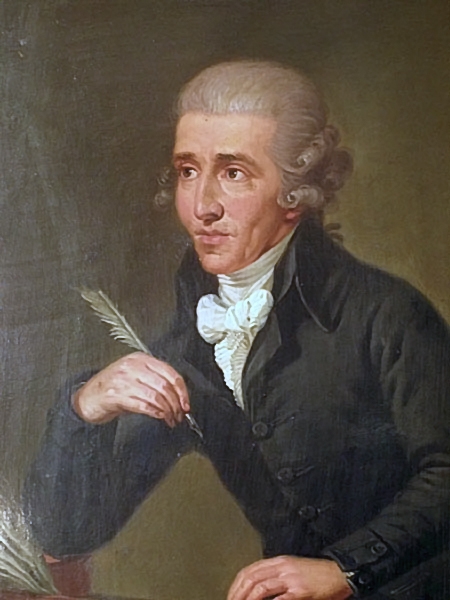
Joseph Haydn c.1770 by Ludwig Guttenbrunn
The musicologist, Sir Donald Tovey, wrote that “every page of the six quartets of Joseph Haydn’s Op. 20 (1772) is of historic and aesthetic importance… there is perhaps no single or sextuple opus in the history of instrumental music which has achieved so much”.
No 5 of the set is in the dark key of F minor. Stringed instruments resonate more freely and richly in keys where the open strings happily resonate, such as D major and G major, so Haydn’s choice of F minor is a deliberate limiting of the brighter tones of the instruments, making for an appropriately sombre and dramatic sonic mood. This could be seen to be a response to the claustrophobic and lonely predicament that Haydn and his fellow musicians found themselves in at the isolated Esterházy palace where they were employed by Prince Esterházy.
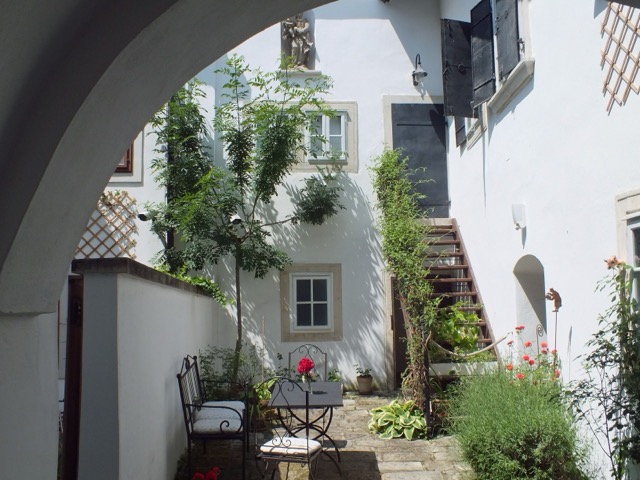
The courtyard of Haydn’s house in Eisenstadt, near the Esterházy palace, fifty miles south of Vienna.
Haydn’s empathy with his colleagues is always apparent in his writing, and despite the intense atmosphere in this music, there are several moments for each player where an unexpected note or surprising new phrase lifts the spirit or even raises a smile. For example, the beautifully shaped arioso of the slow movement suddenly evaporates, the pulse and flow of the music disappearing, making musicians and listeners alike wonder whether they have lost the plot completely.
This work ends with a fugue, the ultimate compositional tour de force, and a way of showing the absolute interdependence of the parts and conversational interplay that is at the core of Haydn’s art. By using a time honoured Baroque technique he was distancing himself from the ‘galant’ style fashionable in the late 1700s.
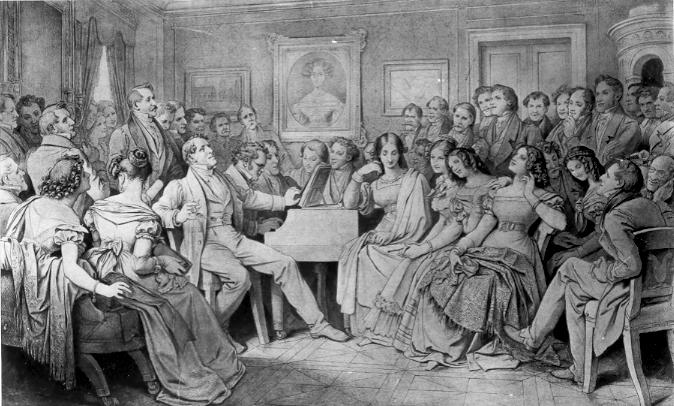
A Schubertiade music gathering, with Franz Schubert at the piano and a picture of Caroline Esterházy on the wall behind him. By Moritz von Schwind
Franz Schubert, when asked some forty years later by a member of the Esterházy family (distantly related to Haydn’s employer) who he was close to, Countess Caroline Esterházy, to compose some music for her, is believed to have replied: “What’s the point? Everything is dedicated to you anyway.” Despite his infatuation with her, she did not return his love. The dichotomy of hope and despair is very apparent in Schubert’s music, no more so than in the G major string quartet D. 887, the last quartet that he wrote (1826). Only the first movement was performed in his lifetime. As with so much of his music, it was the good fortune of future generations to discover the wonders of Schubert’s music, for voice, for solo piano music and various instruments.
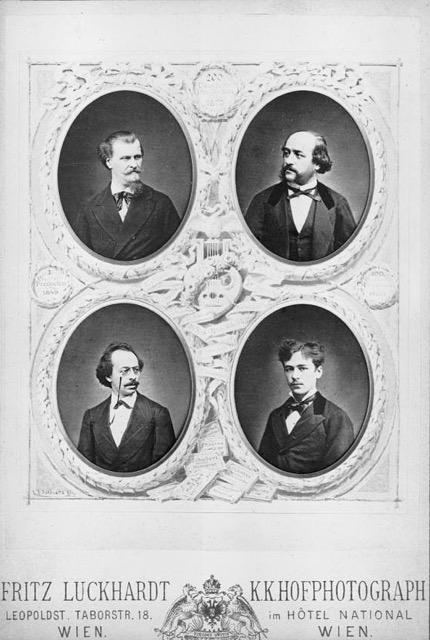
The Hellmesberger Quartet (c.1872) who gave the first performance of the G major quartet in Vienna’s Musikverein in 1850, 22 years after Schubert’s death.
The G major quartet is a visionary work, vast in scope, sometimes cataclysmic, sometimes consoling. The relatively small forces – just the four ‘voices’ of the string quartet – are masterfully crafted by Schubert to convey the extremes of scale that he was wanting to express in this later part of his career; not that he really had a ‘late’ period, as he was only 31 when he died (in 1828.) Anton Bruckner, born two years before Schubert’s death, expanded, in his symphonies, on what Schubert started. There is a strong affinity between the two composers.
Hope/despair is apparent at the very outset – the G major opening statement immediately driven out by G minor. (One is reminded of the opening of ‘Also Sprach Zarathustra’ by Richard Strauss.) This contrast continues throughout the work. ‘Quartet in G major’ is somewhat of a misnomer. Schubert goes to so many far away places, often rendering G major a distant memory.
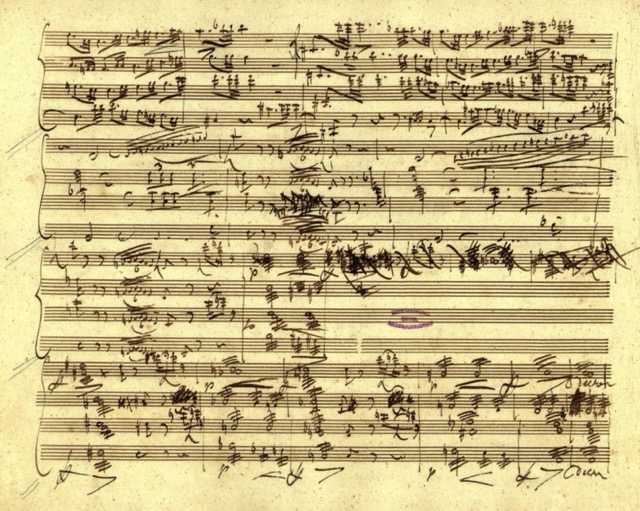
Schubert’s autograph manuscript of the nightmarish section of the slow movement of the G major quartet.
It feels, when playing this music, that Schubert’s use of dramatic harmonic shifts and tremolo bowing take the genre to bursting point. What on earth would he have come up with had he lived longer?! Perhaps this work could be described as being in the spirit of expressionism. It would take another ninety years or so before expressionism became an art movement as such, but it is not such a big leap from this Schubert quartet to music by the early 20th century iconoclasts, Schönberg and Webern.
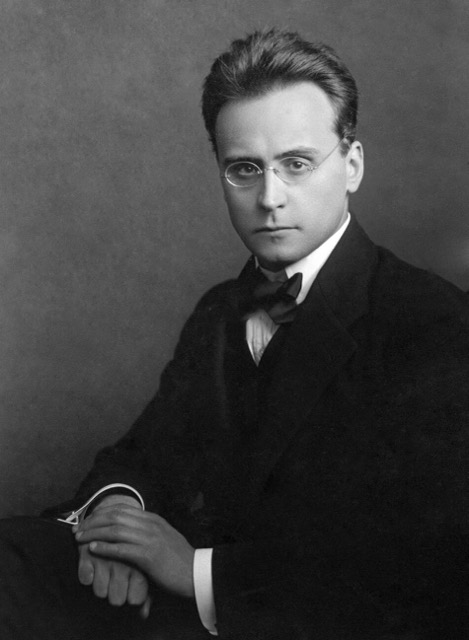
Anton Webern in 1912
Anton Webern sought out Arnold Schönberg for lessons and became his most famous pupil. Both were convinced of the need to develop a way of writing music that extended outwards from classical norms and that would truly reflect the zeitgeist. It took them to a place that many critics found too difficult. Their influence though was profound and Webern in particular is now seen by many as a guru like figure, who pared music down to its essentials and somehow told legends in pieces lasting sometimes no longer than a few seconds.
Before becoming a Schönberg pupil, Webern was taught by Guido Adler, one of the founders of musicology as a discipline, who in turn had been a pupil of Bruckner. Bruckner’s teacher, Simon Sechter, was a fugue addict. He wrote 5,000 fugues, and tried to compose one every day. When our disillusionment with the internet becomes absolute and we look at other available salutary distractions and priorities, the revival of the practice of fugue writing may well become a norm of the daily routine, for some anyway.
Perhaps this link between Webern and Haydn is a touch tenuous, but there is no doubt that the fugue is a musical form as disciplined as the ‘twelve-tone’ system that Schönberg and his acolytes espoused.
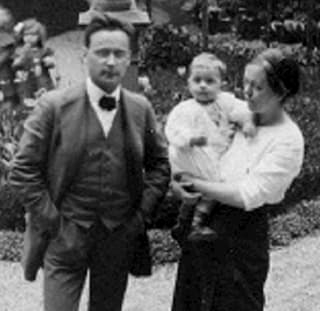
Anton and Minna Webern with their daughter Amalie.
Webern wrote ‘Langsamer Satz’ (Slow Movement) near the beginning of his studies with Schönberg. It may even have been an exercise, drawing on the sound world and mood, to some extent, of Schönberg’s intensely confessional Verklärte Nacht. There is hardly a hint of the radical new path that they were both about to go along. It is believed to have been written after a hiking holiday in the mountains near Vienna with his cousin Minna, who he later married. It is a warm and romantic movement, a meditation, perhaps, on being in the Alpine landscape that he loved, and that he saw so effectively depicted in the paintings of one of his favourite artists, Giovanni Segantini. Maybe there is a hint of anxiety too that resonates with the complex psycho drama of Verklärte Nacht.
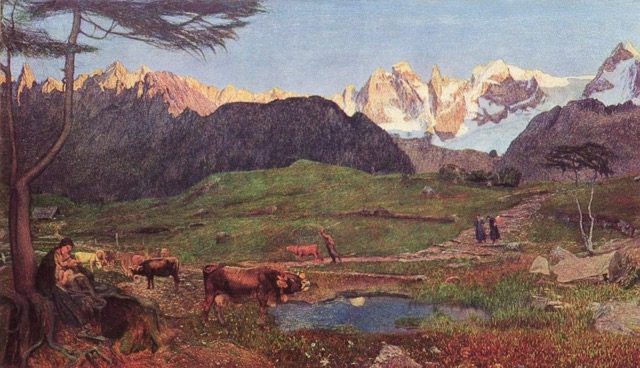
Alpenlandschaft bei Sonnenaufgang, by Giovanni Segantini. (Stadel Museum, Frankfurt am Main)
It is believed that Langsamer Satz was not performed in Webern’s lifetime (he died in 1949, in absurd and tragic circumstances, shot in error by an American soldier.) It was given its first official performance in 1962, by the University of Washington String Quartet.
Recent Comments